The untold story of the visionary architects who created
Hawai’i Modernism.
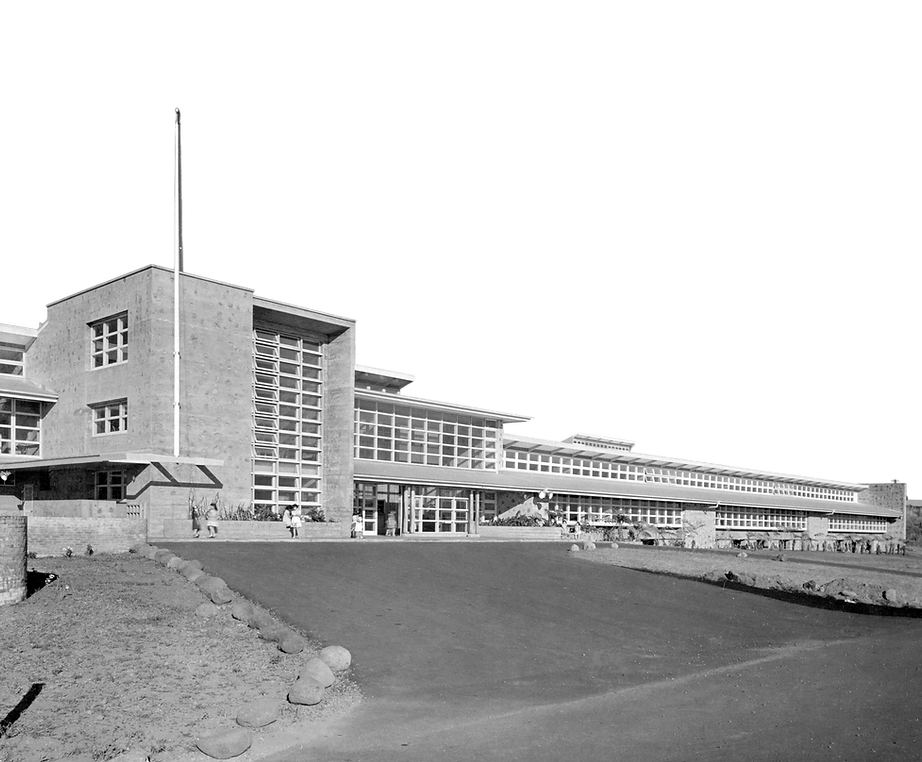
Mid-century modernism is experiencing a global renaissance. While Palm Springs, Brasília, and Southern California dominate the narrative, the remarkable story of Hawai‘i Modernism remains largely untold.
SHAPING PARADISE moves beyond the “exotic” stereotypes of Hawai‘i to explore its profound, radical architectural history and show how a young, diverse group of creatives built a highly progressive, resource-scarce modernism shaped by wartime trauma and regional necessity. Alfred Preis’s extraordinary life anchors a story of displacement, resilience, and the power of architecture to shape memory, identity, and place.

Synopsis
Alfred Preis, a Viennese Jew fleeting the Holocaust in 1939 was locked up in a U.S. internment camp after the Pearl Harbor attack only to become the visionary behind the iconic USS Arizona Memorial (1962). This film uncovers how an Austrian refugee, a Russian émigré, and a group of local architects rejected rigid Western design to invent Hawai’i Modernism – forever transforming the architectural soul of the Pacific. However, SHAPING PARADISE is more than an architecture documentary; it is a gripping human story of displacement, resilience, and art overcoming geopolitical trauma.


What is Hawai‘i Modernism?
European Modernism sought to control nature—enclosing space behind walls of stone, steel, and glass. Hawaiʻi demanded the opposite. Here, architecture had to welcome the climate rather than resist it. Emerging from wartime scarcity, cultural diversity, and a tropical environment, a young generation of architects reimagined modernism for the Pacific. Inspired by Frank Lloyd Wright, informed by Pan-Asian traditions, and shaped by local materials, they dissolved the boundaries between inside and outside, replacing rigid enclosure with openness, ventilation, and landscape. Hawai‘i Modernism was not a regional variation of European modernism—it was its reinvention.

The Story
In the summer of 1939, Alfred Preis and his newlywed wife Jana escape Nazi persecution, leaving behind family members who would perish in the Holocaust. Arriving on O‘ahu, Alfred Preis steps into Honolulu’s emerging modern design scene, where he befriends and joins a young generation of architects shaped by the Great Depression—bringing with him the ideas, discipline, and cosmopolitan spirit of Vienna. Two years later, following the attack on Pearl Harbor, most foreign nationals—including the young Jewish refugee Alfred Preis and his wife Jana—are arrested under the Enemy Alien Act and imprisoned in U.S. internment camps.
Following his release in 1943, and amid a wartime construction ban, Preis joins a circle of architects who rejected imported architectural models in favor of a new regional modernism shaped by climate, material scarcity, and Hawaiʻi’s multicultural identity. From this renewed spirit of collaboration emerged Associated Architects, a remarkable collective that would redefine postwar architecture
in Hawaiʻi:
-
The Russian Master — Vladimir Ossipoff (1907-1998) who defined the language of Hawai’i Modernism through landscape, climate, and craft. Having grown up in Japan, Ossipoff integrated traditional Japanese influences into his design.
-
The Austrian Exile — Alfred Preis (1911-1994) who translated Viennese modernism into the tropical architecture of Hawaiʻi
-
Two college friends - Allan Johnson (1906-2000) & Thomas Perkins (1906-1996). Their firm, Johnson & Perkins sought to create kama‘aina architecture.
-
Philip Fisk (1906-1957) who brought large scale project experience to the islands.
Parallel, other architects kept defining Hawai’i Modernism. Among them prominent were Pete Wimberly, Ed Bauer, Harry Seckler, Kenji Onodera.
Over the next two decades, this group of young architects fused the intellectual mainstream modernism with the tropical spirit of Hawai’i, with Preis advocating and designing the USS Arizona Memorial at the Pear Harbor in Oahu (1962). Suspended above the sunken battleship, the memorial sags at its center to evoke defeat before rising at either end as a gesture of hope and renewal. The USS Arizona Memorial is one of the most recognized monuments in the United States and visited by millions each year.
At the height of his architectural career, Preis turned to public service, founding the Hawaiʻi State Foundation on Culture and the Arts and authoring of the first public art Funding bill in the world.
Born from wartime trauma, migration, material scarcity, and extraordinary artistic collaboration, Hawai‘i Modernism transformed the architectural identity of the Pacific. More than a regional variation, it reimagined modernism through climate, cultural exchange, and environmental responsiveness—issues that resonate more urgently today than ever before.
However, Shaping Paradise is more than an architecture documentary; it reveals how a displaced architect helped redefine both the architecture and cultural identity of Hawaiʻi and a gripping human story of displacement, resilience, and art overcoming geopolitical trauma.